Your Closing Disclosure
The short version
The Closing Disclosure is the final version of your Loan Estimate: five pages with your actual loan terms and every cost. You must receive it at least 3 business days before you sign. For this rule, Saturdays count, but Sundays and federal holidays do not. For example, if you receive it on Monday, you can close on Thursday of a week with no holiday.
Use those days to review it. Put your latest Loan Estimate beside it and check the following:
- The loan type, term, amount and rate match what you locked.
- The monthly payment and mortgage insurance look right.
- Your earnest money and seller credits show up, and the cash to close makes sense.
- Your name is spelled correctly.
Page 3 does some of the work for you. Its Calculating Cash to Close table puts each Loan Estimate figure next to the final one and says whether it changed. If closing costs rose more than the rules allow, it says by how much, and page 2 shows the credit you are owed.
Because Colorado property taxes are paid a year behind, expect a seller credit on page 3 for the seller's share of this year's taxes. On rural homes, review Sections C and H for water and septic tests, a survey or improvement location certificate, and road or water association fees, and check that each is split the way your contract says.
Go deeper
What can change, and by how much
The rules compare your final costs with your Loan Estimate in three groups:
| Limit | Costs |
|---|---|
| No increase | Fees paid to the lender, the broker or their affiliates; services you could not shop for; transfer taxes |
| 10% in total | Recording fees, and services from a company on the lender's list |
| No limit | Prepaid interest, homeowner's insurance, property taxes, escrow deposits, services from a company you found yourself, optional services |
The limits move only when a cost rises for a valid reason the lender put on a revised estimate in time, such as a change you asked for or a low appraisal. Otherwise the lender must refund the excess within 60 days of closing. The refund shows as a lender credit, noted as covering costs above the legal limit.
Changes that restart the clock
Most corrections arrive in an updated Closing Disclosure without moving your closing. Three changes require a new disclosure and a fresh 3-business-day wait:
- The APR rises by more than 1/8 of a percentage point on most loans.
- The loan product changes, such as fixed to adjustable.
- A prepayment penalty is added.
Two more timing rules matter. A revised Loan Estimate has to reach you at least four business days before closing, and once the Closing Disclosure is out, changes go on the disclosure. If it is mailed or emailed, you are treated as receiving it three business days after it is sent, unless you confirm receipt sooner. Answer the lender's receipt request the day it arrives.
Page by page
- Page 1: loan terms, projected payments and costs at closing, laid out like the Loan Estimate.
- Page 2: every cost, split by who pays: you at or before closing, the seller, or others. Section B is now services you did not shop for and C is services you did, so a company you picked from the lender's list moves from C to B.
- Page 3: the cash to close comparison, then a summary of the deal: price, deposit, seller credit, and adjustments for taxes or dues.
- Page 4: loan features such as assumption, late fees, partial payments and your escrow account.
- Page 5: total of payments, finance charge, APR and total interest, plus contacts and NMLS numbers.
Lines worth a second look
- Deposit: your earnest money appears as a credit on page 3.
- Seller credit: matches your contract and any later amendment.
- Title and closing fees: split between you and the seller the way the contract says.
- Homeowner's insurance: the premium matches your policy, and the months collected for escrow look right.
- Prorations: taxes and HOA dues credited or charged for the right dates.
- Unfamiliar charges: ask what each one is and who chose the company.
Questions are normal. Ask them during the waiting days rather than at the signing table.
See it with your numbers
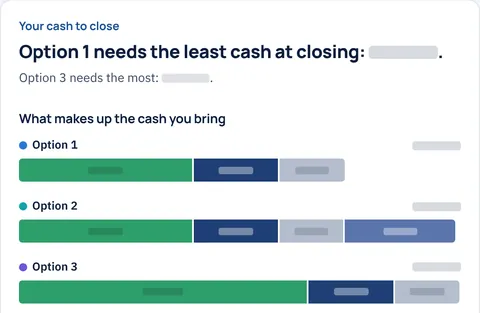
Your Mortgage Plan's payment and cash to close breakdowns give you a line-by-line reference to hold your Closing Disclosure against.
Already have a Mortgage Plan? Open your link, or text Daniel.
Back in your Mortgage Plan, see this with your own numbers.