Points and the break-even
The short version
A discount point is a fee paid at closing to lower your interest rate. One point is 1% of the loan amount, so on a $300,000 loan one point is $3,000. Points can come in fractions, such as 0.5 or 1.25.
How much a point lowers the rate varies by lender, loan type and the day's market. The key question is always how long it takes for the lower payment to repay the cost.
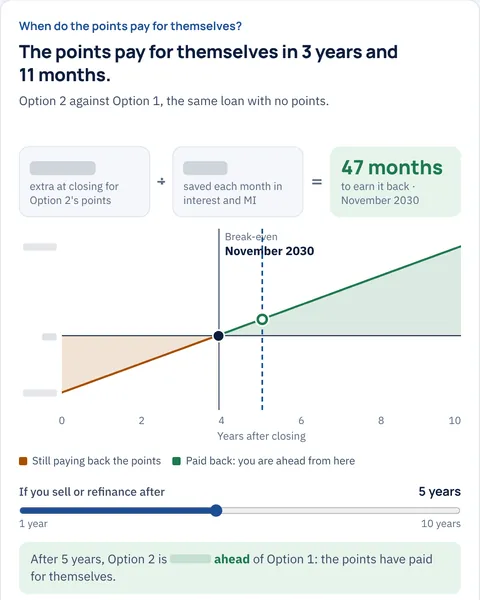
Cost of points ÷ monthly savings = months to break even.
For example, if points cost $3,000 and save $50 a month, you break even in 60 months, or five years. If you keep the loan longer, the points have paid for themselves. If you sell or refinance sooner, they cost you money.
The same approach works in reverse. A lender credit pays some of your closing costs in exchange for a higher rate.
Rates move every day with the market. When you are ready and the numbers look right, we lock.
Go deeper
Where points show up
On page 2 of the Loan Estimate, points are the first line of Section A, shown as a percent of the loan amount and in dollars. Points listed there must buy a lower rate. Lender credits appear in Section J as a negative number.
Some lenders call any fee calculated as a percent of the loan a "point," even when it does not lower the rate. Ask which kind you are looking at, and ask every lender to quote the same points so the rates compare fairly.
Points on a home purchase may be tax deductible. IRS Topic 504 explains the rules, and your tax preparer can tell you whether they apply to you.
Points, more down, or cash in the bank
The same few thousand dollars can work in different ways:
- Buy points: a lower payment for the life of the loan, once you pass the break-even month.
- Put more down: a smaller loan. On a conventional loan, reaching 20% down means no monthly mortgage insurance.
- Keep it: reserves for repairs, job changes and the surprises a new home brings.
If you sell or refinance before the break-even, the points have not paid for themselves. The longer and more certain your plans, the better the math on points looks.
Seller-paid points and temporary buydowns
A seller credit can pay for points, within your loan's limit on seller credits. That lowers your rate for the life of the loan.
A temporary buydown is different. Money set aside at closing, often from the seller, lowers your payment for the first year or two. Lenders generally qualify you at the full rate, and the payment steps up when the money runs out. It eases the early years but does not change the loan's rate.
Price the same credit both ways, in dollars. Your break-even and how long you will keep the loan determine which saves more.
See it with your numbers
Your Mortgage Plan shows the break-even month for every option with points, using your own loan amount.
Back in your Mortgage Plan, see this with your own numbers.