Reading the room: how to negotiate
The short version
Good negotiation starts with reading the listing. Three signals show how much room there is to negotiate:
- Days on market: a home that has been on the market longer than others nearby usually has more room. Ask your agent for the full history, since a relisted home can show a new count.
- Price history: price reductions, relistings and an earlier contract that fell through all suggest a seller who is motivated to sell.
- The seller's situation: a vacant home, an estate, a job relocation or the cost of carrying a second house. Your agent can ask what matters most to the seller: price, timing or certainty.
The next step is deciding what to ask for. A lower price reduces your loan and payment for as long as you keep the loan. A seller credit pays closing costs, so you bring less cash to closing. The two cost the seller about the same, but they affect you differently.
Comparable sales are limited in parts of Southwest Colorado, so a price well above recent sales can be difficult for an appraiser to support. That is one more reason a lower price can be better than a credit in this area. Snow can also delay roof and septic inspections, so allow for winter in your deadlines and in what you ask for.
Go deeper
Price cut or credit: the math
For example, suppose the home is $300,000, you are putting 5% down, and the seller will give $6,000.
- Price cut to $294,000: your down payment decreases by $300 and your loan decreases by $5,700. You save $300 at closing and pay less every month.
- $6,000 credit: your loan stays the same, and your cash to close decreases by up to $6,000 if your costs are at least that amount.
If you are short on cash, the credit usually helps more. If you have ample cash and plan to stay, the price cut continues to save you money. A credit can also pay for points to buy down your rate, so check the break-even before you choose.
Sellers often prefer a credit because the recorded price stays higher. You can use that preference in your negotiation.
Limits on seller credits
Each loan limits how much the seller can pay toward your costs, as a percentage of the price (or the appraised value, if lower):
| Loan | Seller credit limit |
|---|---|
| Conventional, home you will live in | 3% with less than 10% down, 6% with 10% up to 25% down, 9% with 25% or more |
| Conventional, investment | 2% |
| FHA | 6% |
| VA | 4% in concessions; your normal closing costs do not count toward it |
| USDA | 6% |
A credit cannot exceed your actual closing costs and prepaids, and it cannot cover your down payment. If the seller is willing to give more than you can use, ask for the rest as a lower price.
When there are multiple offers
Price is not the only factor. Sellers also weigh certainty and timing:
- A strong file: a pre-approval with income, assets and credit already checked
- More earnest money: it shows commitment, but it is at risk if you miss a deadline
- Flexible dates: a closing date or rent-back that fits the seller's move
- Shorter inspection periods, with the inspection still included
- Appraisal gap coverage: a commitment to cover part of a low appraisal in cash, only if you actually have that cash beyond your down payment and reserves
- An escalation clause: raises your offer above competing offers by a set amount, up to a limit you choose
On rural homes with a well or septic system, we recommend keeping the inspection, even with multiple offers.
After the inspection: repair, credit or price
Start by sorting the inspector's findings. Safety and system problems are worth negotiating, while normal wear usually is not.
FHA, VA and USDA appraisers can require health and safety repairs before closing. A credit will not satisfy that requirement; the work must be done. For other items, a credit or a lower price is often simpler than asking the seller to hire contractors.
Get a contractor's bid before you make a request. A figure from a contractor carries more weight than an estimate, and it keeps the conversation focused on the house.
See it with your numbers
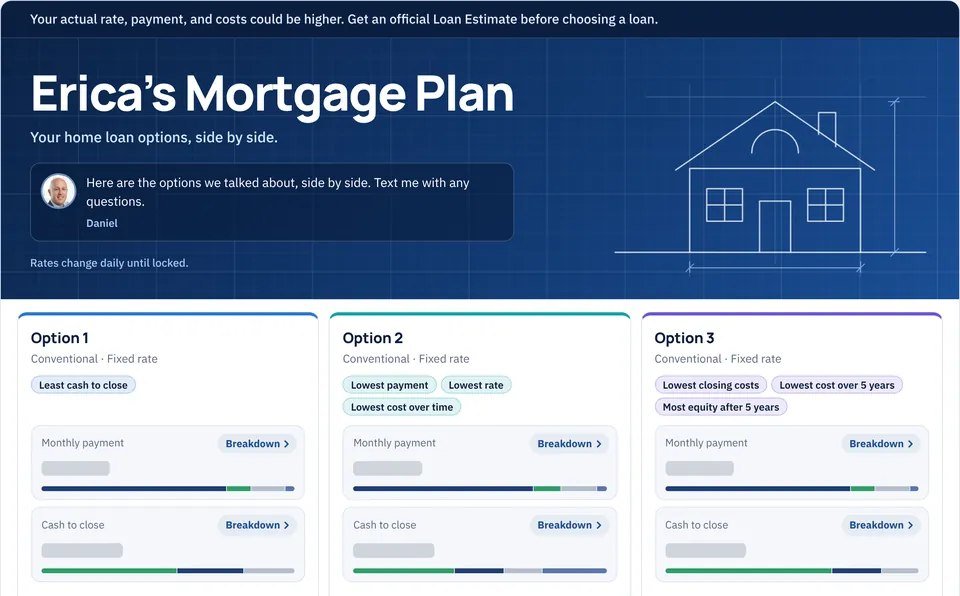
Your Mortgage Plan can show a price cut and a seller credit as separate options, with the payment, cash to close and cost over time for each.
Already have a Mortgage Plan? Open your link, or text Daniel.
Back in your Mortgage Plan, see this with your own numbers.