
How much house can you afford?
The short version
Lenders start with one ratio: your monthly debts, including the new house payment, divided by your monthly income before taxes. This is called your debt-to-income ratio, or DTI.
The house payment includes everything that comes with the home: principal, interest, property taxes, homeowners insurance, mortgage insurance and any HOA dues. The debts are the payments on your credit report, such as car, student loan and credit card payments, plus obligations such as child support. Utilities, phone bills and groceries do not count.
Each loan type treats the ratio its own way. Conventional loans approved through Fannie Mae's automated system go up to 50%. FHA sets no fixed maximum for automated approvals. VA sets no maximum at all and looks at residual income instead. USDA's guideline is 41%, and its automated system can approve more.
The amount a lender approves is not a target. Your own monthly limit should come first, with room for savings, childcare and upkeep on the home.
In Southwest Colorado, two homes at the same price can cost very different amounts each month. Property taxes vary by county and district, and insurance can cost more in wildfire areas or far from a fire station. Rural homes add costs that lenders do not count, such as propane, well and septic upkeep, snow removal and longer drives. Before you settle on a budget, get an actual tax figure from the county assessor and an insurance quote.
Go deeper
How lenders count income
Lenders use income before taxes that is steady and likely to continue.
- Salary and hourly pay: your base pay, usually supported by a two-year work history. Job changes are acceptable when they make sense.
- Overtime, bonus and commission: usually averaged over the last two years, and only if it is likely to continue.
- Self-employment: the income your tax returns show after deductions. See buying when you are self-employed.
- Other income: Social Security, pensions, disability and support payments can count with proof that they will continue.
Front-end and back-end ratios
The back-end ratio counts all your debts plus the house payment. It is the ratio most approvals depend on. The front-end ratio counts the house payment alone.
VA sets no maximum debt-to-income ratio. 41% is VA's standard; above it, the lender looks closely at residual income, the money left each month after the house payment, debts and taxes. Above 41%, VA asks for residual income at least 20% above its guideline, or a written justification from the underwriter's supervisor. Strong residual income often allows VA to approve veterans whose debt ratio appears high.
| Loan | All debts, as a share of income |
|---|---|
| Conventional | Up to 50% with Fannie Mae's automated approval. Manual: 36%, up to 45% with strong credit and reserves. |
| FHA | No fixed maximum with automated approval. Manual: 31% and 43%, up to 40% and 50% with compensating factors. |
| VA | No maximum. 41% is the standard; above it, residual income decides. |
| USDA | 29% for housing and 41% for all debts. The automated system can approve more; a manual approval up to 32% and 44% needs a 680 score. |
Debts that surprise people
- Student loans in deferment still count. If no payment appears, most programs count a portion of the balance instead.
- Loans you co-signed count, unless you can show that the other person has made the payments, usually for the last 12 months.
- Paying off a debt to qualify can help. Paying off a small loan removes its entire payment from the ratio. Paying down a credit card lowers its minimum payment only slightly.
Ask us before you move any money, because cash spent on debts may be cash you need at closing.
What lenders do not count, but you should
A lender's calculation leaves out many everyday costs. Before you shop, add up the following:
- Upkeep. A common rule of thumb is about 1% of the home's value each year.
- Utilities, which can rise sharply in a larger or older home.
- Childcare, commuting, and saving for retirement and emergencies.
Then choose the monthly payment you are comfortable with and work back to a price. That number is your budget, even if your approval is higher.
See it with your numbers
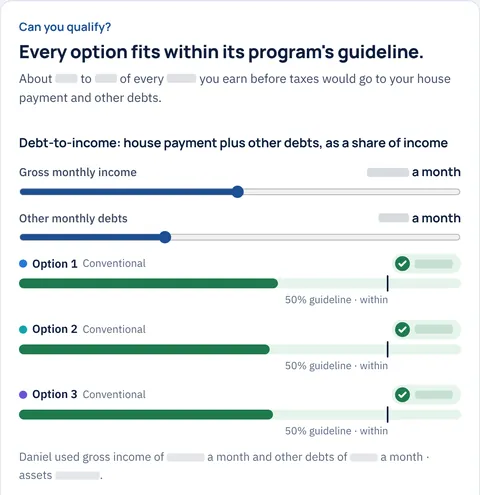
Your Mortgage Plan shows your qualifying ratios for each option, figured from your own income and debts.
Back in your Mortgage Plan, see this with your own numbers.
Your next step
Lesson 2 of 7 in Am I ready?Where your credit standsYour credit score sets which loans fit and what they cost. VA and USDA set no minimum score, and small changes can move you into better pricing.Read the lessonOr go another way: I am not sure buying is better than renting