
USDA loans: nothing down outside town
The short version
USDA guaranteed loans can finance the full price of a home in an eligible rural area. They require no down payment. They carry a 1% upfront fee, which is usually added to the loan, and a yearly fee of 0.35%, paid monthly.
Two checks come first:
- The address. USDA's map determines eligibility. Near the edge of town, the boundary can fall street by street.
- Household income. It can be up to 115% of the area median, and it counts income from everyone in the home, not only the people on the loan.
The home must be your main residence. The land cannot produce income, but there is no set acreage limit. Sellers can pay up to 6% toward your costs. USDA loans are 30-year fixed-rate loans only.
Many rural addresses in Southwest Colorado fall inside USDA's eligible areas, and addresses near the edges of larger towns can fall on either side of the line. Income limits differ by county, so check both the address and your county's limit before you make an offer. Wells, septic and small acreage are common here and work with USDA when they meet its standards.
Go deeper
How household income is counted
USDA looks at income two ways. Household income decides eligibility: everyone in the home counts, even someone who is not on the loan. Repayment income is what the borrowers on the loan use to qualify.
Some items lower the household figure: a deduction for each child under 18, full-time student or household member with a disability, child care for children 12 and under, and certain medical and disability costs for elderly or disabled households. Limits vary by county and household size, so check yours on USDA's eligibility site.
Credit and qualifying
USDA sets no minimum credit score. Its automated system weighs the whole file, and files it does not accept can be underwritten by hand. USDA's guideline is 29% of income for housing and 41% for all debts. Its automated system can approve higher ratios; a manual approval up to 32% and 44% needs a 680 score and a compensating factor.
If a student loan shows no payment, USDA counts 0.5% of the balance each month. You will need to be a U.S. citizen, a U.S. non-citizen national or a qualified alien.
The property
- Main home only. Working farms and other income-producing land are not eligible. Outbuildings are acceptable when they are not used to earn income.
- No set acreage limit, but the appraisal must support the land.
- Well water needs a test showing it is safe to drink.
- Repairs can be part of a USDA purchase. Non-structural work up to $35,000 does not need a separate inspector. See renovation loans.
- Closing costs can sometimes be added to the loan, up to the appraised value.
USDA or another loan?
- Versus FHA: USDA needs no down payment, and its fees, 1% upfront and 0.35% a year, are lower than FHA's 1.75% and 0.55%. Income and address limits apply.
- Versus VA: VA has no monthly fee and no income or address limits. Eligible veterans should compare both.
- Versus conventional: with strong credit and some money down, conventional mortgage insurance can cost less and can be removed later. USDA's yearly fee stays for the life of the loan.
See it with your numbers
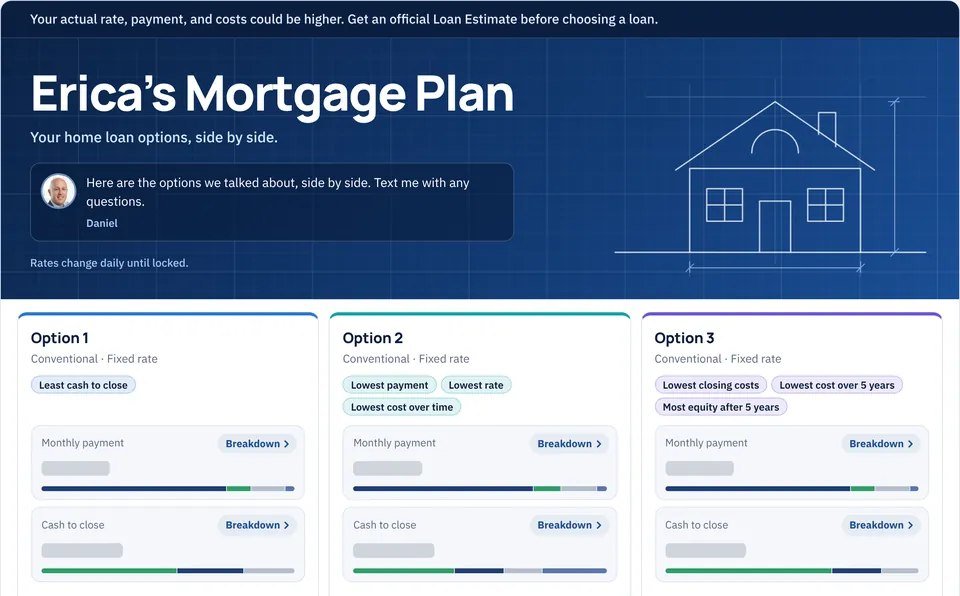
Your Mortgage Plan shows the USDA option with the upfront fee added to the loan amount and the yearly fee in the monthly payment.
Back in your Mortgage Plan, see this with your own numbers.
Your next step
Lesson 4 of 7 in What can I get?Down payment assistance: what it really costsDown payment assistance is often a loan with a second lien, not a grant, and the mortgage that comes with it may cost more. Compare the full cost first.Read the lessonOr go another way: The home has acreageIt has a well or septicThe home needs repairs
Previous lesson: Why VA loans usually win, and who qualifies